N Kolay Payment Institution Inc. General Manager Haluk Yum's 2021 sector assessment and 2022 expectations
The growth momentum of Financial Technologies and Payment Systems will increase in the coming period
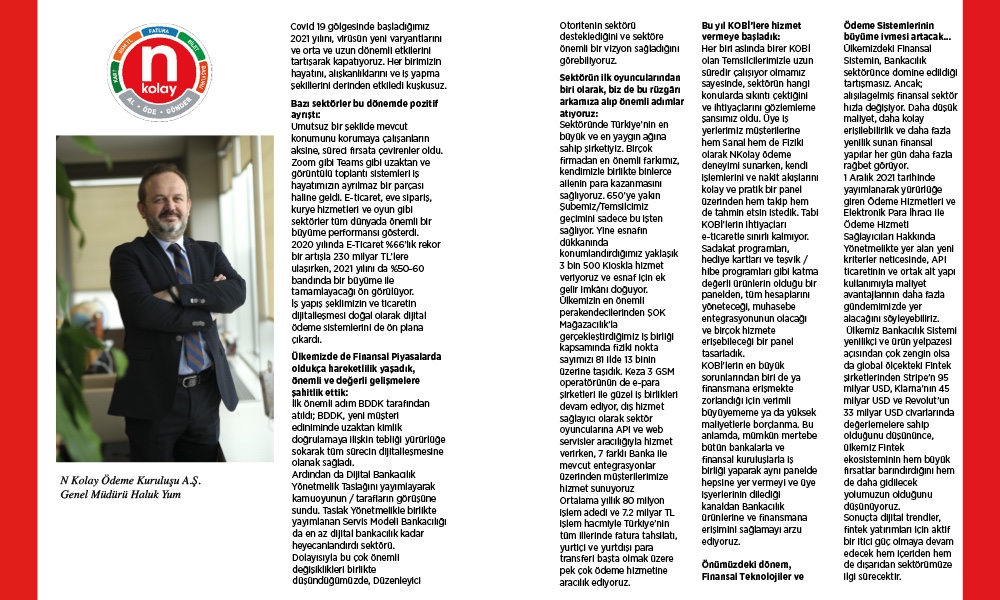
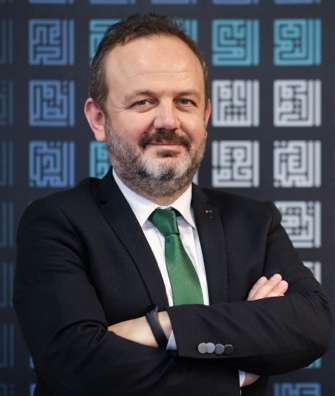
N Kolay General Manager Haluk Yum
fintechtime Article
"We are closing 2021, which we began under the shadow of Covid-19, discussing the new variants of the virus and its medium and long-term effects. It has undoubtedly deeply affected each of our lives, habits, and ways of doing business.
Some sectors stood out positively during this period:
Unlike those desperately trying to hold their current positions, some turned the process into an opportunity. Remote and video meeting systems like Zoom and Teams became an integral part of our work lives. Sectors such as e-commerce, home delivery, courier services, and gaming showed significant growth performance worldwide. While e-commerce reached 230 billion TL with a record increase of 66% in 2020, it is projected to close 2021 with growth in the range of 50-60%.
The digitalisation of our way of doing business and commerce naturally also brought digital payment systems to the forefront.
We also experienced significant activity in Financial Markets in our country and witnessed important and valuable developments: The first significant step was taken by BDDK; BDDK enabled the digitalisation of the entire process by enacting the communiqué on remote identity verification for new customer acquisition. It then published the Digital Banking Regulation Draft and submitted it for the opinion of the public/parties. The Service Model Banking published alongside the Draft Regulation excited the sector at least as much as digital banking.
Therefore, when we consider these very important changes together, we can see that the Regulatory Authority supports the sector and provides an important vision to the sector.
As one of the first players in the sector, we are also taking important steps by riding this wind:
We are the company with the most widespread network in Turkey in our sector. The most important difference from many companies is that we enable thousands of families to earn money together with us. Nearly 650 of our Branches/Agents earn their living solely from this business. We also provide services through approximately 3,500 Kiosks placed in shopkeepers' stores, creating additional income opportunities for shopkeepers. Within the scope of our collaboration with ŞOK Mağazacılık, one of the most important retailers in our country, we have raised our physical point count above 13,000 in 81 provinces. Similarly, beautiful partnerships continue with the e-money companies of 3 GSM operators; while providing services to sector players as an external service provider through APIs and web services, we also serve our customers through existing integrations with 7 different Banks.
With an average annual transaction count of 80 million and a transaction volume of 7.2 billion TL, we serve as an intermediary for many payment services including bill collection and domestic and international money transfers in all provinces of Turkey.
This year we started serving SMEs:
Thanks to working with our Agents, each of whom is essentially an SME, for a long time, we had the opportunity to observe the challenges the sector faces and its needs. While our member businesses offer their customers the NKolay payment experience both virtually and physically, we wanted them to be able to both track and forecast their own transactions and cash flows through an easy and practical panel. Of course, the needs of SMEs are not limited to e-commerce. We designed a panel with value-added products such as loyalty programmes, gift cards, and incentive/grant programmes, where all accounts can be managed, accounting integration will be available, and many services can be accessed.
One of the biggest problems for SMEs is either being unable to grow efficiently due to difficulty in accessing finance, or borrowing at high costs. In this regard, we desire to cooperate with as many banks and financial institutions as possible, include them all in the same panel, and enable member businesses to access banking products and finance from the channel of their choice.
The growth momentum of Financial Technologies and Payment Systems will increase in the coming period…
There is no doubt that the Financial System in our country is dominated by the banking sector. However, the traditional financial sector is rapidly changing. Financial structures offering lower costs, easier accessibility, and more innovation are increasingly in demand every day. Following the new criteria in the Regulation on Payment Services and Electronic Money Issuance and Payment Service Providers, which entered into force on 1 December 2021, we can say that API commerce and cost advantages from shared infrastructure use will be more on our agenda.
Although our country's Banking System is very innovative and rich in terms of product range, when we consider that global FinTech companies such as Stripe have valuations of around 95 billion USD, Klarna around 45 billion USD, and Revolut around 33 billion USD, we believe that our country's FinTech ecosystem holds great opportunities and that there is still a long way to go. Ultimately, digital trends will continue to be an active driving force for FinTech investments, and interest in our sector will continue both from within and outside.
We are closing 2021, which we began under the shadow of Covid-19, discussing the new variants of the virus and its medium and long-term effects. It has undoubtedly deeply affected each of our lives, habits, and ways of doing business.
Although we did not feel the effects of economic slowdowns much due to the incentives and monetary expansions frequently seen worldwide last year, this year we had commodity and energy price increases on our agenda. Unfortunately, we can say that the increase in these prices will spread more broadly in the coming period and will remain on the agenda for some time.
One of the lasting effects of this period was the entrenchment of income inequality. The World Inequality Report shows that the pandemic rapidly raised the share of the wealthy in global wealth, with inequality increasing to record levels. Unfortunately, we learn that just this year alone, 100 million people in the world fell into the "extreme poverty category".
Some sectors stood out positively during this period:
Unlike those desperately trying to hold their current positions, some found their way in the storm and turned the process into an opportunity. Remote and video meeting systems like Zoom and Teams became an integral part of our work lives. Sectors such as e-commerce, home delivery, courier services, and gaming showed significant growth performance worldwide.
Concepts such as FinTech, Unicorn, Decacorn, Crypto Assets, and Augmented Reality, which we neither knew nor heard of three to five years ago, have become terms we frequently use in our daily lives.
While e-commerce reached 230 billion TL with a record increase of 66% in 2020, it is projected to close 2021 with growth in the range of 50-60%. The digitalisation of our way of doing business and commerce naturally also brought digital payment systems to the forefront. This year we discussed the increase in card payment systems; we will most likely be discussing the rapid spread of QR payments in 2022. Although the sector range of companies reaching market valuations above 1 billion USD and 10 billion USD worldwide is quite wide, we see that Financial Technologies have the largest share in this range alongside e-commerce.
We also experienced significant activity in Financial Markets in our country and witnessed important and valuable developments:
The first significant step was taken by BDDK; BDDK enabled the digitalisation of the entire process by enacting the communiqué on remote identity verification for new customer acquisition. In a sense, BDDK both eliminated a potential obstacle to the pre-Digital Banking Licence process and pre-emptively prevented possible unfair competition for the existing Banking system.
It then published the Digital Banking Regulation Draft and submitted it for the opinion of the public/parties. The Service Model Banking published alongside the Draft Regulation excited the sector at least as much as digital banking. When we consider such important changes as Open Banking, Digital Banking, and Service Model Banking together, we can see how much the Regulatory Authority supports the sector and provides an important vision to the sector.
As one of the first players in the sector, we are also taking important steps by riding this wind:
We are the company with the most widespread network in Turkey in our sector. The most important difference from many companies is that we enable thousands of families to earn money together with us. Nearly 650 of our Branches/Agents, each a family business, earn their living solely from this business. We also provide services through approximately 3,500 Kiosks placed in shopkeepers' stores, creating additional income opportunities for shopkeepers. Within the scope of our collaboration with ŞOK Mağazacılık, one of the most important retailers in our country, we have raised our physical point count above 13,000 in 81 provinces. Similarly, beautiful partnerships continue with the e-money companies of 3 GSM operators; while providing services to sector players as an external service provider through APIs and web services, we also serve our customers through existing integrations with 7 different Banks. With an average annual transaction count of 80 million and a transaction volume of 7.2 billion TL, we serve as an intermediary for many payment services including bill collection and domestic and international money transfers in all provinces of Turkey. N Kolay enables its customers to make payment transactions quickly, easily, and securely.
The growth momentum of Financial Technologies and Payment Systems will increase in the coming period..
There is no doubt that the Financial System in our country is dominated by the banking sector. However, the traditional financial sector is rapidly changing. Financial structures offering lower costs, easier accessibility, and more innovation are increasingly in demand every day.
The agile nature of FinTechs and their ability to collaborate with third parties and platforms much faster than Banks, and to develop products that address more segments, enables them to capture a share of banks' existing and future customer bases. For this reason, we can say that the Bank-FinTech relationship, which today takes the form of "Bank – Customer", will become more of a business partnership in the coming period, and that Banks and FinTechs will even start launching joint products.
Following the new criteria in the Regulation on Payment Services and Electronic Money Issuance and Payment Service Providers, which entered into force on 1 December 2021, we can say that some consolidations are highly likely, and that API commerce and cost advantages from shared infrastructure use will be more on our agenda.
Although our country's Banking System is very innovative and rich in terms of product range, when we consider that global FinTech companies such as Stripe have valuations of around 95 billion USD, Klarna around 45 billion USD, and Revolut around 33 billion USD, we believe that our country's FinTech ecosystem holds great opportunities and that there is still a very long way to go.
Ultimately, digital trends will continue to be an active driving force for FinTech investments, and interest in our sector will continue both from within and outside."
Bu web sitesi, deneyiminizi iyileştirmek ve site trafiğini analiz etmek için çerezler kullanmaktadır.
Çerez Politikamız hakkında detaylı bilgi alabilirsiniz.
 Türkçe